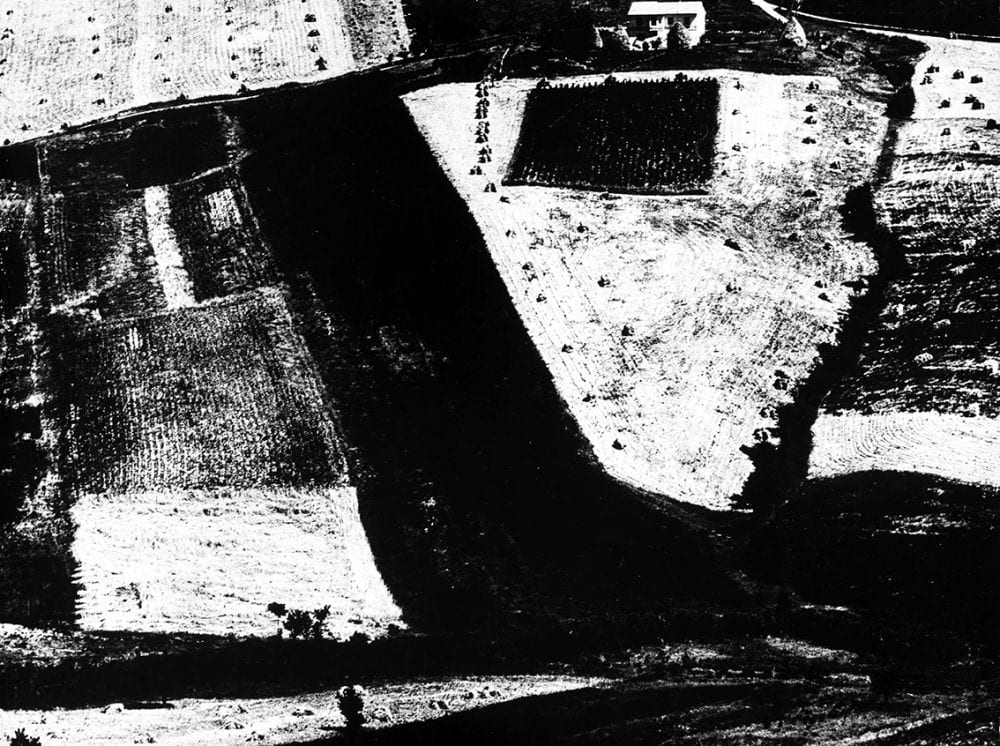
For this series, Giacomelli photographed a farmhouse front on, positioning himself on the cultivated Marchigian hillside at Sant’Angelo, a province of Senigallia. Giacomelli photographed the land as the seasons changed and the years passed. Over decades, with the evolution of farming technique and the advent of intensive agriculture, the region was overhauled. The land’s morphology is testament to Le Marche’s deterioration; its loss of coherence and stability, its fragmentation, collapse, infertility, and death. In Giacomelli’s photographs from the 1950s/60s, we find sheaves of wheat and a wide variety of crops, whose cultivation forms geometric patterns and signs, but, by the 1970s/80s, this landscape had disappeared.
‘By photographing the land I am trying to kill nature. I want to steal back the life that nature has been granted, I’m not sure by whom, which has been destroyed by man’s involvement, and I want to give nature a new life, I want to recreate nature according to my criteria, my vision of the world. Nature is my own mirror, I find myself reflected in it, and so by saving this land from the sadness of its devastation, I also want to save myself from the sadness buried within me. Sometimes I even use an expired roll of film, a material that has already died, precisely to emphasise this sensation, and to give the effect of blacks seeping into the surrounding area.’
(Mario Giacomelli, handwritten notes, 1990s, Courtesy of the Mario Giacomelli Archives).