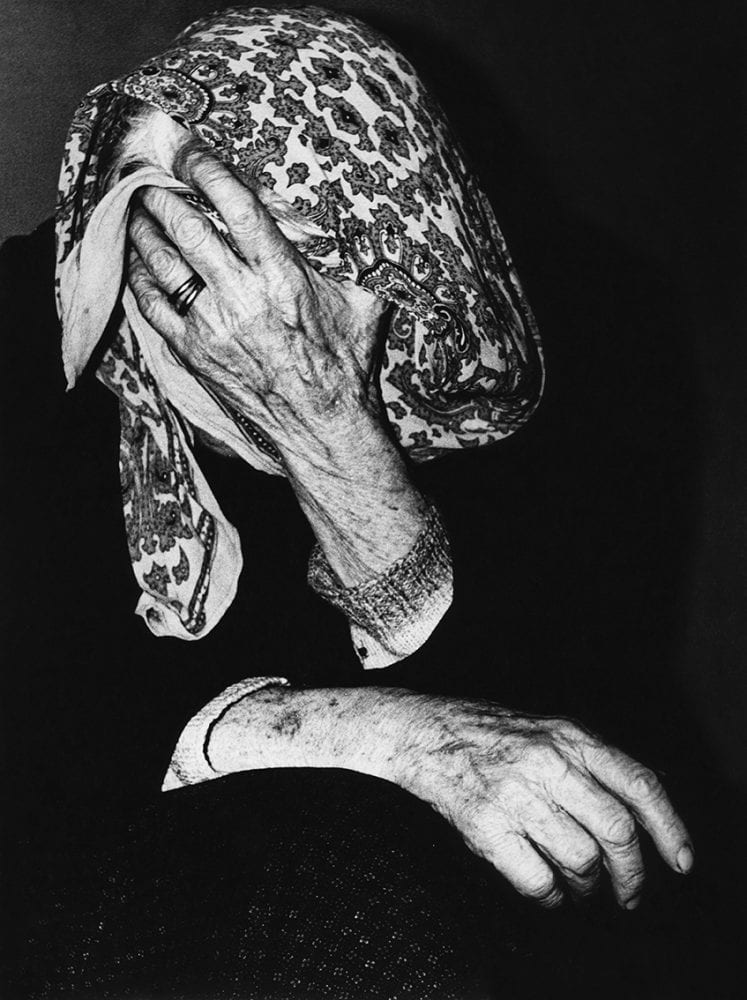
This series takes its title from Cesare Pavese’s poem Death will come and will have your eyes. It was compiled during the second stretch of time that Giacomelli spent photographing in the hospice in Senigallia (1966/68), and it was expanded using photographs from his first period there (1954/56).
‘Of all the things I’ve done, I think this is my most interesting project; I have felt more things during my time in the hospice than I have through all my other projects put together. […] Why? Why, having battled all your life, must this be the end, why does it have to come down to these environments, these absurd institutions?
[…] These photographs are more realist, and this is true of the technique I used too. I chose a different method of printing [high contrast prints on heavier paper], and starkly cropped the images, which I’ve done in other series, but these simply feel more real than the others. Rather than expose what was in front of me, I wanted to expose what was inside me, what was growing within me slowly but surely, the longer I spent embedded in this reality: this fear of getting old, not of dying, this disgust at the price you have to pay at the end of your life.
I worked in such a way that I became one of them, like them, they were no longer aware of the camera I was carrying.’
(A C Quintavalle, Mario Giacomelli, Feltrinelli, Milan, 1980).
‘The hospice photos were the means by which my father wanted to enter reality, to get right under the skin of those worn bodies cut away from their context by close frames, under their bed sheets, corroded by the biting white flash, to access the pain and loneliness of those wretched people abandoned for the last years of their lives. The intense black feels like an abyss into which the elderly subjects are about to fall, and it makes us realise how engulfing loneliness is. Even if I was only a few years old at the time, I remember that my grandmother Libera, who worked as the laundress in the Senigallia hospice, used to take me with her. Together, we went into the huge, cold, damp room. I remember all the water overflowing from the basins of linen onto the floor. In the room there were various wash stations, and each woman had her own, with a wooden platform to keep her feet from getting wet. In one corner there were mountains of dirty sheets, stained by sweat and excrement, and the stench mixed with the smell of the soap. The laundresses didn’t have gloves and the water certainly wasn’t hot. I remember how the sheets were hoisted up from the basins to be hit, and the water sprayed everywhere. Although I was little at the time, it was painful watching my grandmother at her “trocco” (platform), as she called it, she seemed so small and vulnerable.’
(Rita Giacomelli, unpublished notes)
Giacomelli had witnessed the same scenes from a young age when his mother Libera brought him with her to work, having been widowed very early on.