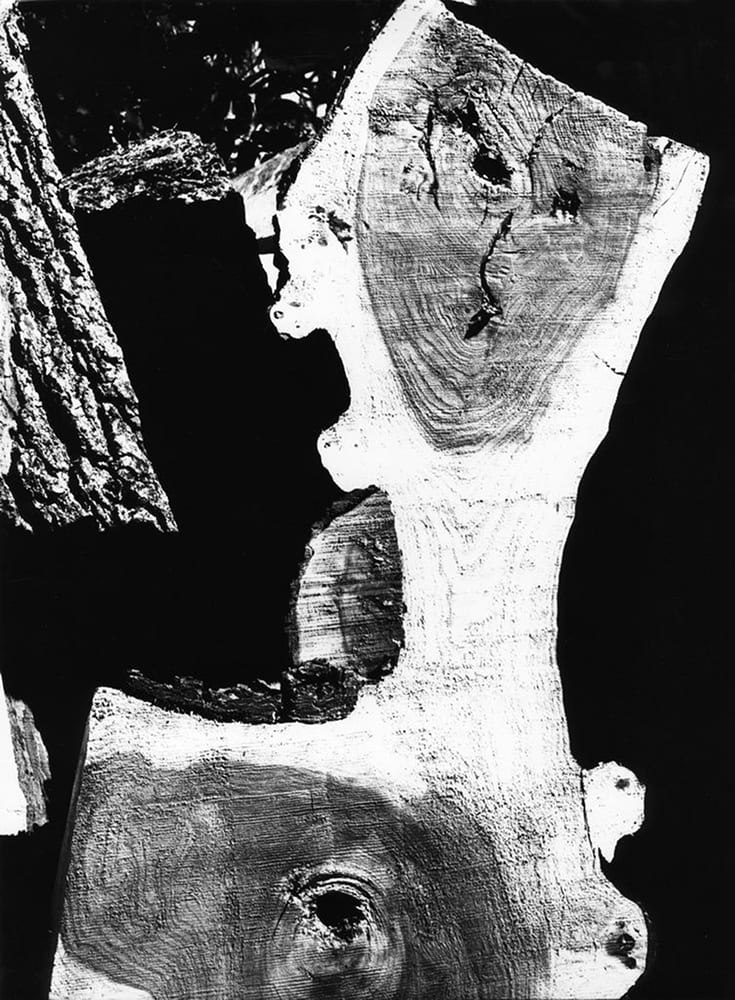
The subjects of this 1966 series are cross-sections of tree trunks cut with a chainsaw. When photographed, their veins and markings, seen front on and close to, and through Giacomelli’s visionary approach, suggest bodily forms, human faces, wombs, breasts, maternity, foregrounding the patterns of rebirth and mutation set in motion by photography; or else they become landscapes. The grooves in the wood become flesh, wrinkles, earth.
‘Through this material metamorphosis, Giacomelli competes against time, assuming the uncontested role of creator, reconstructing the world as a whole inextricable entity, an imagined place that gathers things together without defining and thus dividing them. He even eliminates the greatest distance of all, that between life and death, and in doing so, exorcises death.’
(K Biondi, Mario Giacomelli. Sotto la pelle del reale, 24 Ore Cultura, 2011 / Mario Giacomelli. Under the skin of reality, Schilt Publishing, 2015).
‘I went to these places to seek out abstract forms and instead the first image I encountered made me think: here’s the face that the farmer should have had, he didn’t have the right expression when I photographed him, but here it is etched in the wood, and here’s the land too, with its textures, wrinkles, a condensation of everything I had wanted from the farmers.’
(M Giacomelli in G Celant, Mario Giacomelli, Photology – Logos, 2001).