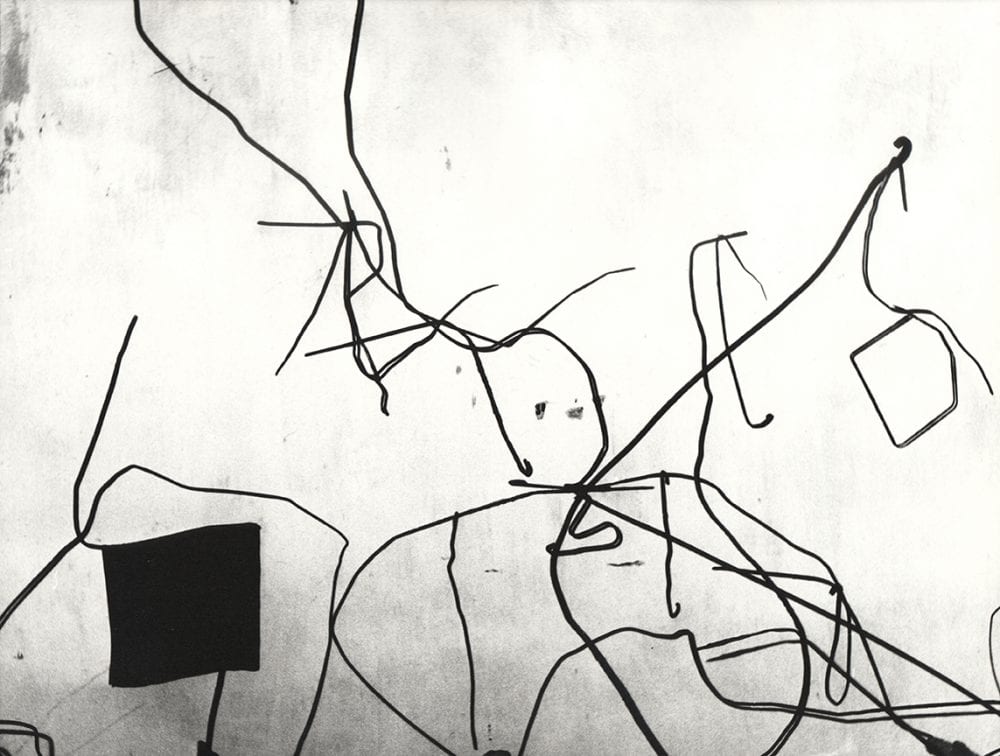
Poesie in cerca d’autore (Poems in search of an author) comprises Giacomelli’s late works. Giacomelli essentialised his style and synthesised his whole poetic approach into scenic constructions of a void: a space that allows room for epiphany. It is here that Giacomelli’s imagination becomes visible, and the contorted metal wires against the crumbling wall become a tangle of dynamism and mystery, like animated drawings, or human figures taking form right before us. Cavalli believed that ‘every photograph is a story’, while Crocenzi maintained that ‘photographs must be understood in their totality, like a story’. It is a shame that they never got to witness how Giacomelli’s approach evolved in his latter years.
The subjects of these photographs are iron wires and the crumbling walls of a dilapidated, disused building. The images emanate the passing of time. Everything is performance, and the photograph is pure invention. Only that which we see exists. The textures of the past are nestled in the crevices of the wall, and, as Giacomelli writes, ‘everything becomes something else’.
The contrast between the bitten white walls and the deep black of the wires (so dense that their shadows seem solid too) eliminates all that is superfluous, and opens the space to movement. The wires enact anthropomorphic associations that feel subtler than those in the 1966 series Motivo suggerito dal taglio dell’albero (Motif suggested by the cut of the tree).
Before beginning to photograph, Giacomelli spent hours preparing the scene, right down to the most minute details. The materials he found on site assume the shape of his interiority (a performative 1990s reworking of Nouveau Realisme?): his gestuality is tangible.