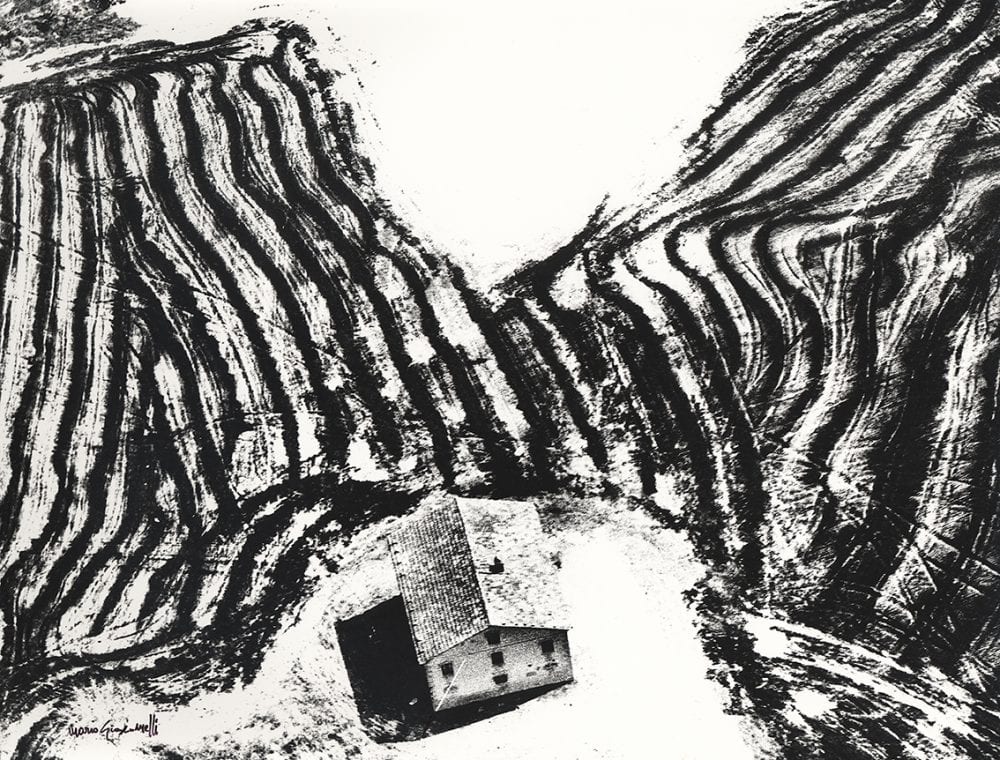
These are aerial photographs taken from a Piper plane.
Giacomelli’s photographs from this period are high contrast: through abstracting and essentialising forms, they emphasise the importance of signs. The crux of Giacomelli’s approach is (as we read in his notes for his test prints) retaining the vitality of the material.
‘A landscape is a means of total expression, where I feel nature upraised and time thrown into traumatic flux. It reduces space to a single emotion. It’s an extension of my existence, its rhythm and repetition filtered through a flow of images. I don’t reproduce the landscape, but its signs, these memories of “my own” landscape. I don’t want it to be immediately identifiable, I would prefer it to recall certain signs, to recall the folds or furrows in the palm of one’s hands. This vision of agriculture used to fascinate me because I saw the landscape as a pure and powerful means of documentation, with everything still to be discovered, lived. But then I realised that I was in fact photographing my inner self, that through the landscape I found my soul. […] The land has its own signs, its own folds, and it was calling out to be photographed, or so it seemed. Its signs presented themselves so that the soul could relish them, they were inner signs reflected in creative action, in constructive destruction. The land became a voyage of desire, sensitivity, penetration, and orgasm because it didn’t just echo the visible world. Perhaps I never really photographed the land: I simply loved it.’
(Mario Giacomelli, handwritten notes 1990s, Courtesy of the Mario Giacomelli archives)