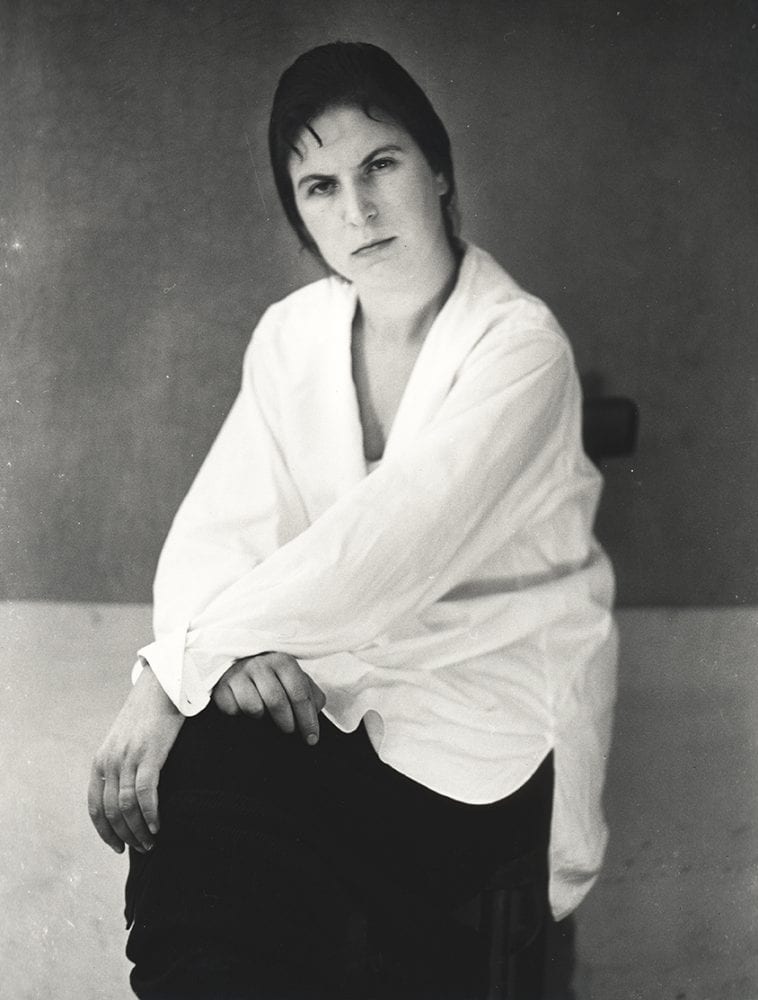
These portraits are some of Mario Giacomelli’s earliest works. Giacomelli began by photographing his friends, family, and colleagues at his ‘Marchigian Typography’. He photographed the everyday world around him, but the images he produced were steeped in his own interiority.
Initially, Giacomelli thought that representing human life bound him to using human subjects. Over decades, however, he moved steadily further into abstraction. His commitment shifted from subject to space. Giacomelli explored how space is inhabited by signs; how stories dwell within it; how signs become new subjects, assuming the same anthropomorphic presence as humans. Signs speak of and for human feeling, fear, and passion. Giacomelli became increasingly convinced of the paucity of literal representation. He believed that no words (or images; equivalent and interchangeable in his eyes) were capable of narrating reality. Photography is a language with its own grammatical rules and rhetorical forms. Giacomelli’s photography is analogous to poetry, even when not in explicit dialogue with published poetic texts.
These early works do, however, emerge from reality and demonstrate the distinct sensitivity of his initial approach. Giacomelli’s practice first evolved in the context of amateur photography competitions which favoured a ‘realist’ outlook, driven by the strong currents of neorealism within Italy’s post-fascist climate. Giacomelli encountered two divergent approaches: while Paolo Monti advised him to stay faithful to reality and resist the draw of formalism, Giuseppe Cavalli, on the other hand, advocated a form of visual lyricism and reality lived from inside-out.
Giacomelli’s early work thus addresses social themes. His portraits explore everyday hardship: humble workers, the toil of farmers, the anguished lives of elderly hospice residents, the young priests with no hands to caress their faces, the sickness and hope he encountered on his pilgrimages to Lourdes, a young couple’s vision of love, the people of the South, and the thorny issue of Italy’s North-South divide.
In these portraits Giacomelli encapsulates an atmosphere of mystery and carnal materiality. This is enfolded in the photographs’ bitten contrasts which decontextualise the subject. The subjects’ expressive faces, with their black depths and brilliant whites, seem to burn with hidden presences.